
ChainThink
Stay ahead, master crypto insights
The Golden Age of Prediction Markets: Polymarket Mania, Kalshi Makes an Appearance
The Golden Age of Prediction Markets: Polymarket Mania, Kalshi Makes an Appearance

2025-09-05 13:51
Original Title: "The Golden Age of Prediction Markets: Polymarket Frenzy, Kalshi Enters"
Original Source: OneKey Chinese
From the 2024 U.S. presidential election to the AI boom and sports events in 2025, prediction markets are heating up. Polymarket's trading volume increased by over 300% during the election, and the pricing power of on-chain "collective wisdom" has never been so widely noticed. According to data from Polymarket Analytics, the cumulative trading volume of top on-chain prediction markets has exceeded $1 billion, with nearly 30,000 markets established, covering topics such as politics, technology, sports, and crypto.
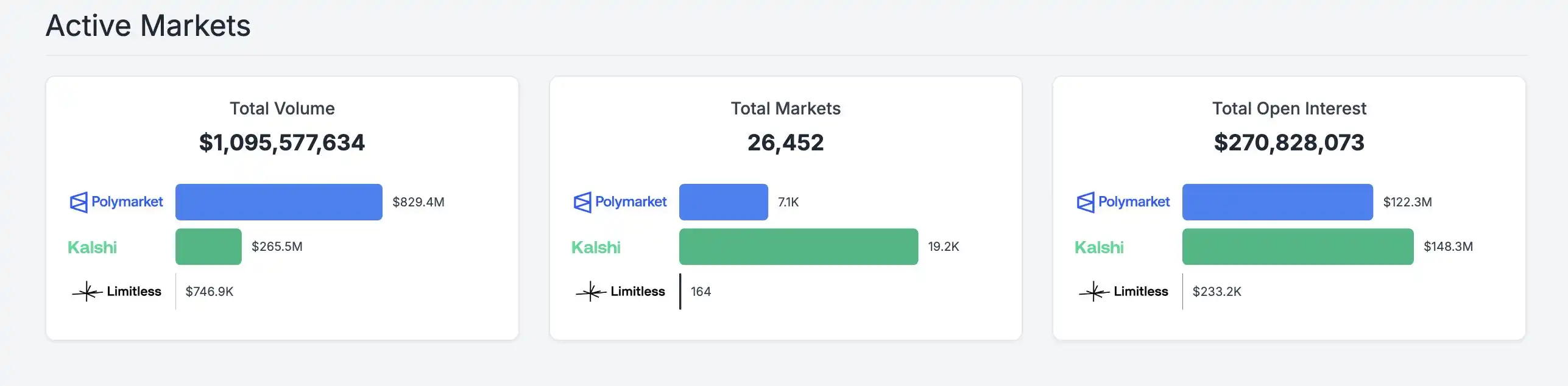
Why now? On-chain prediction markets are more transparent, secure, and censorship-resistant than traditional platforms; plus, U.S. regulations are gradually easing, with players like Coinbase and Kalshi entering the space. These markets are attracting more users and capital, no longer just entertainment betting, but becoming a new tool for information verification: when users bet with real money, the price itself reflects the probability judgment based on collective wisdom.
Such characteristics are particularly prominent in major events. For example, in the 2024 U.S. presidential election, Polymarket priced Trump's chance of winning at 97% before mainstream media; even when polls still showed a "50-50" split, the market had already given a preference of over 60%. The betting money made probability not just an empty talk, but a signal worth considering.
So, how do these markets work? What is the difference between the on-chain prediction mechanism and the traditional model we are familiar with?
"Basic Mechanism of On-Chain Prediction Markets"
To understand on-chain prediction markets, let's first clarify how users place a "bet" in traditional prediction markets.
Suppose there is an event market about "whether the Federal Reserve will cut interest rates in September," with only two outcomes: "will cut" or "will not cut."
Bob believes the economy is weakening and that it is highly likely to cut rates, so he bets $60 on "will cut"; Alice and James each put $20 and $12 on "will not cut." In this case, a total of $92 is bet in the market, with $60 on "will cut" and $32 on "will not cut." On traditional platforms, users do not see "probability," but rather odds. For example, the platform might show "will cut" odds of 1.53 times and "will not cut" odds of 2.88 times.
The odds actually reflect the probability derived from the distribution of funds: > "Will cut" ≈ 60 ÷ 92 ≈ 65% > "Will not cut" ≈ 32 ÷ 92 ≈ 35%
The side with more bets has lower odds, and the return is less if it wins; the side with fewer bets has higher odds, and the return is richer if it wins. For example, if rates are actually cut, the $60 bet can take $92, with odds of approximately 1.53 times; if not cut, the $32 bet can take $92, with odds of approximately 2.88 times.
This is the operating logic of traditional prediction markets: user bets drive changes in odds, and the odds implicitly reflect the market's expected probability of the event outcome.
"How Polymarket Moves Gambling onto the Chain"
Another core characteristic of traditional gambling is its static and one-way nature. Once a bettor places a bet, their funds are locked until the event ends and is settled. This process is irreversible. Bettors cannot adjust their positions during the event based on new information or changing circumstances. There is no secondary market where bettors can "sell" their bets to lock in profits or reduce losses. To break this limitation, prediction markets introduced the core mechanisms of financial markets, thereby achieving a paradigm shift from "betting" to "trading." We will use the example of the "Will the Federal Reserve cut rates in September 2025?" market to analyze the complete flow of funds.
Stage One: Market Creation
On Polymarket, anyone can create a prediction market without permission. When the market is created, smart contracts automatically generate tradable shares corresponding to the event outcome, such as "Yes" and "No." The total number of shares is fixed, with each "Yes" and "No" share having a total value of 1 USDC. The market creator provides initial liquidity and receives corresponding shares, thus determining the initial price.
Stage Two: Opening a Position
Assume that at the beginning of the market, the market believes the probability of a rate cut is 40%: "Yes" shares price at 0.40. Alice believes the probability of a rate cut is underestimated and buys 100 "Yes" shares at 0.40, spending $40 USDC. Alice's counterparty is Bob, who sells 100 "Yes" shares (or buys 100 "No" shares). Alice's $40 and Bob's $60 are locked in the smart contract as collateral. Alice receives 100 "Yes" shares, and Bob receives 100 "No" shares.
Stage Three: Market Fluctuations
Assume that the inflation report shows economic cooling exceeding expectations. The likelihood of a rate cut increases significantly, and the "Yes" share price rises to 0.75. Alice's holdings increase in value from $40 to $75, realizing a $35 profit.
Stage Four: Closing the Position
Alice decides to sell her shares to lock in the $35 profit. Trader James believes the rate cut is a certainty and is willing to buy at 0.75. Alice's sell order matches with James' buy order. James directly pays $75 USDC to Alice. Alice's "Yes" shares are transferred to James.
Alice's $35 profit comes from James paying a higher price. At this stage, no principal loss has occurred. Therefore, before settlement, traders' profits come from other traders. Your profit is paid by the person who bought your shares at a high price, and your loss is the difference you pay to the person who took over your shares at a low price.
Stage Five: Event Settlement
Assume Alice and Bob hold their shares until the Federal Reserve meeting ends. The result confirmation and fund allocation logic: the oracle confirms the final result. If "Yes" occurs, the "Yes" shares are worth $1.00, and the "No" shares are worth zero. Winners exchange their shares for the funds locked in the smart contract. Losers lose their invested principal.
For example, if the Federal Reserve announces the "Yes" result, Alice exchanges her 100 "Yes" shares for $100 USDC. Alice's profit is $60, and Bob loses all $60. Alice's $60 profit is exactly Bob's $60 loss.
It can be seen that on-chain prediction markets like Polymarket are peer-to-peer, without a "house" as in traditional gambling platforms. Fund flows are entirely between participants, managed automatically and transparently by smart contracts. Trading profits come from the real-time changes in other traders' judgments of event probabilities, while settlement profits directly come from the principal invested by traders holding opposite views. This entire process achieves decentralized, trustless fund transfers, providing the crypto community with a more open "betting" world.
More importantly, when you predict the future, you are not just "talking": you are betting with real money. This characteristic can play a significant role in major events. Intuitively, the larger the total amount bet, the more meaningful the probability reflects the possible outcome, and the more it aligns with reality.
Therefore, when you want to determine whether a piece of news is true, changes in prediction market probabilities can help you greatly. The most classic case is the 2024 U.S. presidential election. Haseeb, a partner at DragonFly, pointed out in a tweet analysis that the world's largest prediction market, Polymarket, had already made a decision before mainstream news media, declaring Trump's chance of winning at 97% before midnight Eastern Time. Moreover, even when poll models indicated a 50-50 chance for Trump and Harris, Polymarket had already given its answer — Trump's chance of winning was over 60%.
On-chain prediction markets have far surpassed being just a gambling betting platform: through blockchain technology and financial methods, they have the potential to become a new channel for information dissemination and verification.
"On-Chain vs. Compliance, Why Kalshi Is Criticized"
Compared to Polymarket, another prediction market, Kalshi, recently sparked controversy by appointing 23-year-old crypto influencer John Wang as the head of its crypto business. This appointment took place around August 25, 2025, aimed at expanding its digital asset sector. Upon the announcement, Kalshi's investors, including members of Paradigm and Multicoin Capital, gave very positive responses.
Kalshi is another major player in on-chain prediction markets. Over the past few months, they completed a $100 million funding round at a $1 billion valuation, partnered with xAI, integrated Grok into the prediction market, and had members of the Trump family as strategic advisors... At the same time, Kalshi is also the first completely regulated event contract market in the U.S. under the CFTC (Commodity Futures Trading Commission).
However, there are some opposing voices within the native crypto community regarding Kalshi: Delphi Digital member Jordan pointed out that Kalshi's centralized structure is not suitable for promoting as a crypto project; Uniswap team member Niko also stated that Kalshi should not be respected for spreading negative information during the election period, which damaged Polymarket's reputation and operations.
Although there are some controversies surrounding Kalshi, from a data perspective, it has become one of the main competitors of Polymarket, and its future development cannot be ignored.
"End"
On-chain prediction markets have not only broken the static limitations of traditional gambling, but through the introduction of financial trading mechanisms, achieved a paradigm shift from "betting" to "trading," and demonstrated strong vitality through their transparency and decentralization.
As its mechanisms become increasingly mature, and platforms such as Polymarket and Kalshi continue to develop, on-chain prediction markets are becoming an unstoppable force in future information pricing and risk hedging.
Disclaimer: The content of this article is for knowledge popularization and educational purposes only and does not constitute any investment advice or financial advice; DeFi protocols carry high market and technical risks, and the prices and returns of digital assets are subject to significant fluctuations. Participating in digital asset investments and DeFi protocols may result in the loss of the entire investment amount; please conduct your own research and comply with local laws and regulations before participating in any DeFi protocol, perform risk assessments and due diligence, and make cautious decisions.
Disclaimer: Contains third-party opinions, does not constitute financial advice


Crypto Weekly
Tracking on-chain movements of the smart money and institutions

Frontier Insights
Spotlight on Frontier, trending projects, and breaking events

Regulatory Watch
American Crypto Act – timely interpretations of policies worldwide

Market Analysis
BTC/ETH, Major Cryptocurrencies, and Hot Altcoins Price Trends

Crypto-linked Stocks
Crypto-stock linkage, real-time market quotes and in-depth analysis

Popular Airdrop Tutorial
Selected potential airdrop opportunities to gain big with small investments

Alpha Research
Alpha New Token Research Report, Binance Alpha Operation Suggestions